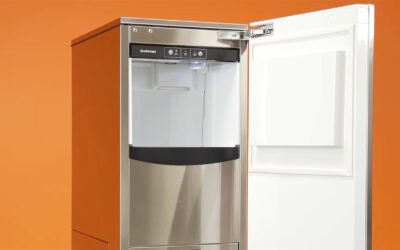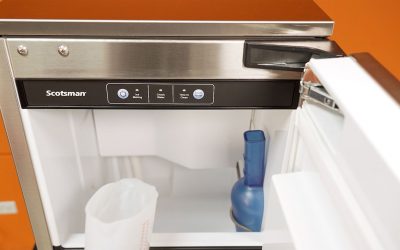

If you’ve ever specified a residential undercounter ice machine in a kitchen, bar, or entertaining space, you already know the ice itself is rarely the challenge. The real questions usually come down to logistics: where does the water go, how does it drain, and what’s the cleanest way to make it work without creating future headaches?
For kitchen designers, architects, and residential builders, the gravity drain versus pump drain decision shows up more often than you might expect. And while it can feel like a technical afterthought, this choice has real implications for reliability, noise, maintenance, and long-term homeowner satisfaction.
Let’s break it down.
Why undercounter ice machines always need a drain
Unlike a refrigerator ice maker, a residential undercounter ice machine is constantly moving water. It uses water to form ice, flushes minerals during each cycle, melts ice during harvest, and releases meltwater from the bin.
The water movement is continuous, not occasional.
Without a drain, an undercounter ice machine would overflow in a matter of hours. So, the question isn’t whether a drain is required — it’s how that drain should work within the layout of the home.
Gravity drains: a solid standard when possible
A gravity drain is exactly what it sounds like: water that isn’t used to make ice or melts in the bin flows naturally downhill from the ice machine to a drain point below. No motors. No switches. No noise.
From a design and installation standpoint, gravity drains are the simplest and most reliable option. They have no moving parts, which means less risk of failures over time. They’re silent — a big deal when the unit lives under a kitchen counter or in the family movie room. They also require less ongoing maintenance.
In practice, if gravity works, installers and manufacturers prefer this method.
When gravity drains make sense
Gravity drainage works when there is a drain point lower than the ice machine’s drain outlet. Common scenarios include homes with basements or crawlspaces, a nearby floor drain, or any other drain that sits lower than the bottom of the ice machine.
In many homes, the only rooms with floor drains are bathrooms and laundry rooms, unless the house was intentionally designed to accommodate specialty appliances. That’s why gravity drains tend to show up more often in certain layouts than others.
The key requirement is continuous downhill slope — at least a quarter inch per foot — with no dips, loops, or kinks in the drain hose.
Pump drains: a practical solution
Pump drains exist for one simple reason: using gravity isn’t always possible when designing a luxury home.
Modern kitchens are often built on slabs. Island installations rarely have floor drains. Sink drains are frequently higher than the ice machine’s drain outlet. In these situations, water has nowhere to drain on its own.
That’s where pump drains come in.
A pump drain collects wastewater from the ice machine and actively pushes it upward or horizontally to a higher or more distant drain point. The pump activates automatically, runs briefly to discharge water, then shuts off.
Pump drains aren’t “better” than gravity drains — they’re simply more flexible.
When pump drains are the right choice
Pump drains are commonly used in slab-on-grade homes, island and bar installations, high-rise residences, or any layout where the only available drain is higher than the ice machine or several feet away.
They make undercounter ice possible in designs that would otherwise rule it out completely.
Trade-offs to consider:
Because pump drains rely on moving parts, they introduce a few additional considerations. There’s a low but noticeable hum when the pump runs. Because of the movable parts, there’s a higher long-term failure risk compared to gravity drains. Scotsman recommends cleaning and descaling the ice machine every six month. This could be more frequent in areas where poor water conditions exist. Please reference Tips for cleaning your Scotsman Ice Machine for more details.
None of these are deal-breakers — they just need to be planned for up front. For design tips you can reference 5 Strategies to Minimize Ice Machine Noise.
Gravity vs. pump: the real-world comparison
From a practical standpoint, gravity drains win on reliability, less noise, and minimal maintenance. Pump drains win on installation flexibility. Neither option is wrong — they simply solve different problems.
A couple things to keep in mind:
- If the drain is nearby and lower than the ice machine, gravity is the clear choice. If the drain is higher or distant, a pump becomes necessary.
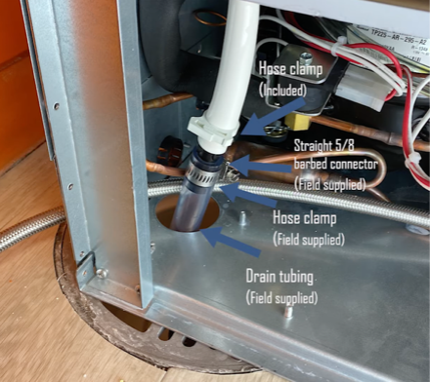
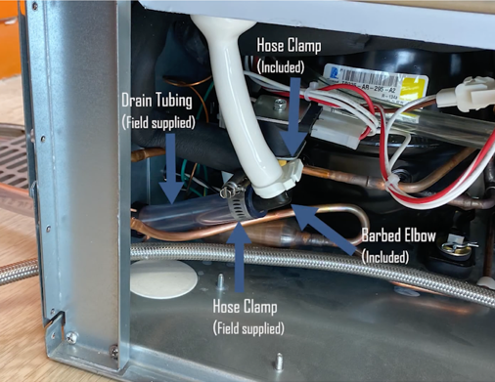
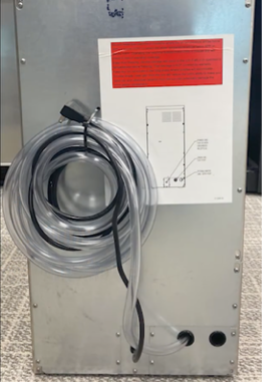
- When utilizing the gravity drain system, it is recommended the installer use tubing specifically designed for undercounter ice machine drainage. Channel the tubing through the “knock out” plate at the bottom of the machine for direct drain access or the “knock out” plate on the back of the ice machine.
- For detail installation information please visit the Brilliance Cuber Installation Video Series or the Brilliance Nugget Installation Video Series.
- If you are uncertain of the drain type, a pump drain ice machine will work in either application.
Design and installation implications
Establishing early whether a project is slab or basement, island or perimeter cabinetry, and where sink drains sit relative to appliance cutouts can prevent late-stage surprises.
For designers and builders, the biggest takeaway is that undercounter ice machines never stop circulating water, and residential kitchens aren’t always designed with that in mind. Choosing the right drain method — and designing for it early — is one of those small decisions that quietly makes everything work and puts the design in the best position to succeed.
Find The Right Machine For Your Home
- For drive-thru quality ice at home, check out our BRILLIANCE® NUGGET ICE MACHINE.
- For crystal-clear, odorless ice cubes, check out our BRILLIANCE® CUBER MACHINES.
- To find a Scotsman dealer near you, search our Dealer Locator page.
- To find a Scotsman service location near you, search our Service Locator page.